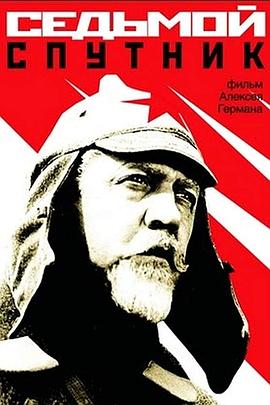
The Seventh Companion (Russian Седьмой спутник, translit. Sedmoy Sputnik) is a 1967 black-and-white Soviet film set in St. Petersburg in the years following the Russian Revolution; its title is commonly translated as The Seventh Companion. The film marked the directorial debut of Russian director Aleksei German, who co-directed it with Grigori Aronov. The film is based on a novel by Boris Lavrenyov.
In the early '90s, the Yugoslavian Government cancelled the autonomy of Kosovo, dissolved its Parliament and closed down the National Television. All institutional life was reorganized by the new authorities, while the majority of the citizens responded with peaceful demonstrations. During this terrible time, Fadili, who works as an archivist, has to choose between two options, knowing that both of them are wrong. He therefore involuntarily and unwillingly swallows the shame, endures the pressure bearing down from all sides and puts up with the bad reputation for only one reason to provide for his family.
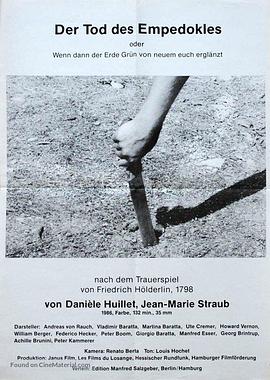
The subject of Danièle Huillet and Jean-Marie Straub’s Der Tod des Empedokles (The Death of Empedocles, 1987) is the Greek pre-Socratic philosopher Empedocles (c. 490 BC – 430 BC), who lived in the Greek colony of Agrigentum in Sicily. His theories are mentioned in several of Plato’s dialogues. He maintained that all matter is made up of four irreducible elements water, earth, air and fire. A mystic and a poet, he is considered to be the founder of classical rhetoric. He is also thought to be the last Greek philosopher to write in verse; two fragments of his works survive Katharmoi (Purifications) and Peri Phuseôs (On Nature). An advocate of democracy, he came into conflict with his fellow citizens of Agrigentum and, as result, was banished with his young disciple, Pausanius. When he was asked to return, he preferred to commit suicide by throwing himself into the active volcano at Mount Aetna. The German writer Friedrich Hölderlin wrote two versions of Der Tod des Empedokles in 1798 and 1800, and a final third version in 1820, all three ultimately unfinished. They were conceived as five-act tragedies and all three differ in plot. According to Michael Hamburger, Hölderlin’s English-language translator, the main reason why Hölderlin finished no version of the play must be that he remained too closely identified with Empedocles, at the very period in his life when his own view of the poet as philosopher, prophet and priest – and as tragic hero – was subject to perpetual crisis and re-examination. Huillet-Straub’s The Death of Empedocles is based on Hölderlin’s first version (the longest of the three), whereas Black Sin is based on the third version.